We focus exclusively on agricultural micro, small and medium enterprises and farmer-producer organisations, and a portion of our portfolio also includes direct farmer lending. The idea is to make agriculture part of the green finance conversation, says T. Vivekanandhan, Lead-ESG and Sustainable, Finance, Samunnati Finance, at panel discussion at The Hindu Sustainability Summit 2025
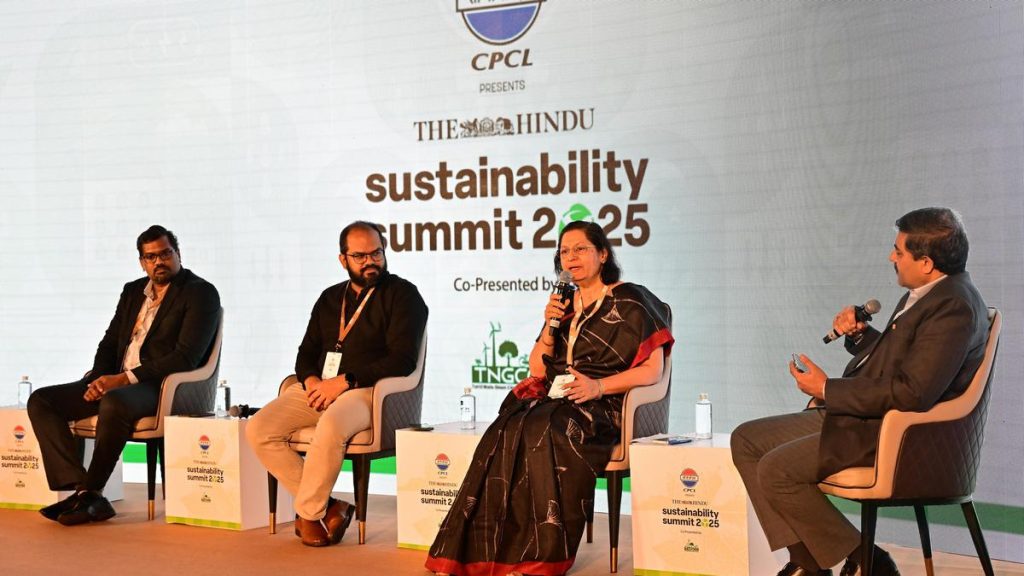
Climate finance experts underscored the need for innovative capital models, reliable data, and stronger private participation to accelerate India’s green transition. They were speaking at a panel discussion on ‘Financing the Green Transition: The Role of Sustainable Capital’ at The Hindu Sustainability Summit 2025.
Climate finance experts underscored the need for innovative capital models, reliable data, and stronger private participation to accelerate India’s green transition. They were speaking at a panel discussion on ‘Financing the Green Transition: The Role of Sustainable Capital’ at The Hindu Sustainability Summit 2025.
T. Vivekanandhan, Lead-ESG and Sustainable Finance, Samunnati Finance, said that while agriculture forms a significant part of India’s economy, it often remains outside the mainstream green finance. “We focus exclusively on agricultural micro, small and medium enterprises and farmer-producer organisations, and a portion of our portfolio also includes direct farmer lending. The idea is to make agriculture part of the green finance conversation,” he said, noting that the sector requires more targeted investment to build resilience and prepare it for climate challenges.
He explained how global investors and institutional funds are increasingly aligning with the UN Principles for Responsible Investment (UNPRI), channelling funds towards companies that demonstrate measurable environmental and social outcomes.
“Earlier, the classification of green finance was broad, but now with frameworks such as the EU’s Sustainable Finance Disclosure Regulation, clearer definitions are emerging. This is helping to ensure accountability in what qualifies as a green investment,” he said.
Shravan Shankar, co-founder of Climake, highlighted the need for blended finance and catalytic capital to bridge the funding gap between the public and private sectors. “Public capital has a market-making role — it can de-risk investments, offer guarantees, and create enabling conditions for private players to participate. But scaling from billions to trillions will require private capital to step in decisively,” he said.
Green financing
Mr. Shankar pointed out that while India’s green financing has grown substantially — with renewable energy, electric mobility, and energy transition sectors leading the way — other critical areas such as adaptation and resilience remain underfunded. “Climate finance today is flowing mostly to mitigation, not adaptation. Public capital must continue to drive climate resilience investments that do not yield direct financial returns but have deep social impact,” he added.
Gita Chengappa, General Manager of TREC-STEP, said the earliest stages of climate innovation — from prototype to proof of concept — are the most financially vulnerable. “Traditional financiers are wary of early-stage climate innovations. Incubators have a crucial role in de-risking such ideas,” she said.
Ms. Chengappa said her team is developing a climate tech finance incubator to offer timely, customised support for early-stage innovators. The initiative will also include a gender inclusion track, led by experts, to support women-led enterprises, recognising that while women often demonstrate strong resource management skills, they continue to face barriers to funds.
The panellists said the lack of reliable, granular datasets continues to constrain the scale and precision of climate-related investments. “Climate is local — conditions vary across districts and even blocks. Yet much of the available data is aggregated at the national or State level, which limits its usability for real-world risk modelling. Without localised data, investors and innovators struggle to design effective solutions,” Mr. Vivekanandhan said.
The session was moderated by N. Ravi Kumar, Senior Deputy Editor, The Hindu.